“I See Myself Again” – Roy’s Story: MR-Guided Focused Ultrasound for Essential Tremor
Roy has always been a man who loved to understand how things worked. An electronic engineer with a naturally inquisitive mind, he approached life with curiosity, humour, and a practical sense of independence. He enjoyed woodwork, maintaining his home, cooking, and especially baking. These were not just hobbies – they were expressions of who he was.
But slowly, and then unmistakably, something began to change.
Roy first noticed the tremor years ago, appearing only in moments of extreme pressure. For a long time, it stayed quiet. But about fifteen years ago, Roy began noticing it in daily tasks – first in writing, then in small, precise jobs he had once completed effortlessly.
“I had done these things all my life,” he said, “but as the shake in my right hand got worse, I had to give them up.”
A visit to a neurologist, arranged by his GP, was to confirm a diagnosis of a benign essential tremor.
At the time, his late wife, Jenny, was well enough to fill in where he struggled. Later, when her health declined, everything changed.
“The kitchen is a dangerous place with sharp knives, boiling water and roasting dishes,” Roy explained. “When Jenny was really ill, that was what exposed the difficulties I was having.”
The impact was not only practical – it was emotional.
The tremor gnawed at his confidence. He dreaded unpredictable moments, like picking up an object and not knowing whether he could control his grip. He found himself hiding the problem.
“To my shame, I sometimes told people lies about why they had to write things for me,” he said. “It ate away at my self-respect and made me anxious.”
But the moment that truly broke his heart was standing at the front of his church – his voice steady but his hand visibly shaking as he held the reading.
“It was simply embarrassing,” Roy admitted. “I love reading in church.”
Medication did not help. And after Jenny passed away, Roy found himself living alone, facing a future where the simplest tasks – cooking, writing, managing the home – were becoming increasingly difficult.
“If I wanted to continue to live an independent life, I had to find a solution.”
Finding Hope in an Unexpected Place
The idea of surgery did not frighten Roy. In fact, he met it with the same practical humour he brought to most challenges. His own mother had undergone far more invasive surgery in the 1930s, and he thought, “if she could do that without anaesthetic, then I can certainly face this.”
Then one day, he came across an article about MR-guided focused ultrasound – a non-invasive treatment that immediately caught his attention.
“It seemed such a wonderfully elegant solution,”
When the team at Queen Square confirmed he was a suitable candidate, Roy felt a mixture of excitement and humility. “Very happy,” he recalled, “tinged with a little bit of: ‘What the hell have I got myself into now?’”
But he never felt alone. Every question was answered clearly. Every fear was acknowledged. Every member of staff – from booking through to the treatment room – seemed deeply experienced, calm, and even cheerful.
“There was a lovely feeling in the air,” Roy said. “And of course, my faith helped too.”
The Day That Changed Everything
On the day of the procedure, Roy felt a sense of stepping into the unknown – but in a good way.
“For me, it was like a peek inside a whole new world,” he said. “I was somewhat apprehensive, but I found it very exciting.”
As the treatment progressed, Roy watched the tremor diminish before his eyes.
“I could see the shake reducing as I went through the treatment,” he said. “By the end, the tremor had gone.”
It was the first time in years that his hand had been truly still.
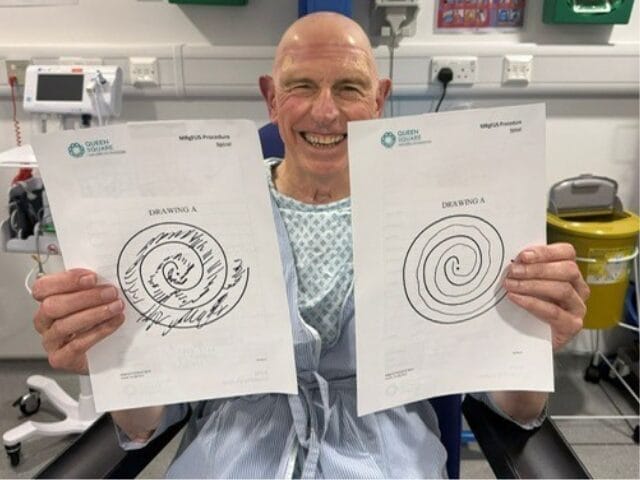
Recovery brought temporary challenges – weakness in one leg, and a little fatigue – but these gradually eased with physiotherapy. What felt stranger, in a wonderful way, was rediscovering the ability to write.
“It still seems very odd being able to write again,” he reflected. “I’ve almost had to learn to write again.”
“I See Me Again.”
Today, Roy’s life is transformed.
“I feel able-bodied again,” he said. “It has restored my independence and confidence so I can live a normal everyday life.”
Things that once felt lost – baking, fixing things, managing daily tasks, contributing to his church – are now simply part of life again. And with them came something deeper: dignity, ease, and hope.
“When I look to the future, I see independence rather than dependence,” Roy said. “I see me again – restored both mentally and physically.”
Roy’s Advice for Others
To anyone living with tremor and considering focused ultrasound, Roy’s message is compassionate, honest, and wise:
“This is brain surgery. You’re awake the whole time, and you’re part of helping the treatment succeed. Listen carefully during the preparation, ask every question – and if you don’t understand the answer, ask again. Stay calm. Some patients breeze through, some feel discomfort. But remember, the people around you are at the very top of their game. Be ready to trust them. And a little humour helps keep the wheels rolling.”
A Closing Thought
Roy’s story is one of resilience, courage, and rediscovery. For anyone living with essential tremor – especially those quietly adjusting their lives around it – his journey offers something powerful: hope.
Because sometimes, the path back to yourself begins with a single still moment.
If you or a loved one is living with Essential Tremor or Tremor-Dominant Parkinson’s Disease and would be interested in learning about what options may be available to you, please contact our treatment team at treatment@queensquare.com or 020 7833 2513.
MORE NEWS